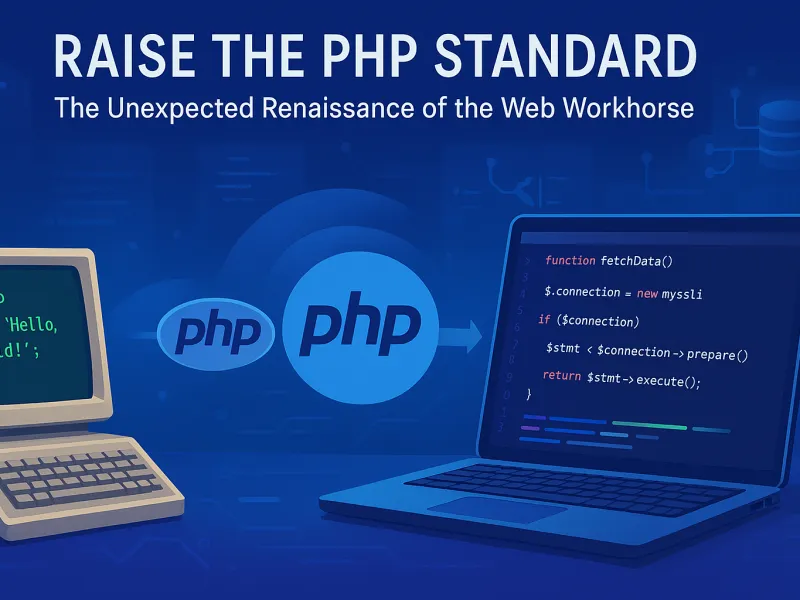
PHP's Humble Beginnings: From Personal Tool to Web Giant
In 1994, Danish-Canadian programmer Rasmus Lerdorf created a set of simple CGI binaries to track visits to his online resume. He called them "Personal Home Page Tools" - and thus, PHP was born. He had no idea that this modest collection of scripts would eventually power nearly 80% of the web.
I started my web development journey around the time PHP 3 was gaining traction. Back then, we stitched together HTML pages with <?php ?> tags, and the concept of "web applications" was still in its infancy. The simplicity was both PHP's greatest strength and its most significant weakness.
"PHP is what happens when you give millions of developers the ability to quickly solve problems without thinking too much about architecture. It's the programming equivalent of duct tape - not always elegant, but incredibly effective."
The Evolutionary Journey: From Scripting to Engineering
The transformation of PHP over the past three decades is nothing short of remarkable. Each major version introduced fundamental improvements that addressed the language's weaknesses while building on its strengths:
Key Milestones in PHP Development
- PHP/FI (1995) - The original "Forms Interpreter" with basic database support
- PHP 3 (1998) - The first version that resembled modern PHP, with extensible architecture
- PHP 4 (2000) - Introduced Zend Engine, bringing significant performance improvements
- PHP 5 (2004) - Revolutionized with full object-oriented programming support
- PHP 5.3 (2009) - Added namespaces, closures, and late static binding
- PHP 7 (2015) - The performance breakthrough with Zend Engine 3 and doubled speed
- PHP 8.0 (2020) - Introduced JIT compilation, attributes, and union types
- PHP 8.1+ (2021+) - Enums, fibers, and ongoing performance optimizations
Code Evolution: Then vs Now
Here's what database interaction looked like in the early 2000s - an approach that makes modern developers shudder:
<?php
// PHP 4 Era - The "Bad Old Days"
$connection = mysql_connect("localhost", "user", "password");
mysql_select_db("my_database", $connection);

// Direct variable interpolation - SQL injection paradise!
$user_id = $_GET['id'];
$result = mysql_query("SELECT * FROM users WHERE id = $user_id", $connection);

while ($row = mysql_fetch_assoc($result)) {
    echo "<li>" . $row['name'] . "</li>"; // XSS vulnerability
}
mysql_close($connection);
?>
Contrast that with modern, secure PHP 8.2+ practices:
<?php
// Modern PHP 8.2+ - Type safety and security first
declare(strict_types=1);

class UserRepository {
    public function __construct(
        private PDO $pdo
    ) {}

    public function findActiveUser(int $userId): ?User {
        $stmt = $this->pdo->prepare("
            SELECT id, name, email, created_at
            FROM users
            WHERE id = :id AND active = true
        ");

        $stmt->execute(['id' => $userId]);
        $stmt->setFetchMode(PDO::FETCH_CLASS, User::class);

        return $stmt->fetch() ?: null;
    }
}

// Usage with proper error handling
try {
    $userRepo = new UserRepository($pdo);
    $user = $userRepo->findActiveUser((int)$_GET['id']);

    if ($user) {
        echo "<li>" . htmlspecialchars($user->name) . "</li>";
    }
} catch (Throwable $e) {
    error_log("User lookup failed: " . $e->getMessage());
    http_response_code(500);
    echo "An error occurred while loading user data";
}
?>
The Modern PHP Revolution: Not Your Father's PHP
The PHP that exists today is almost unrecognizable from its early versions. The language has matured into a robust, efficient platform that holds its own against any modern web technology.
🚀 Performance Breakthrough
PHP 8's JIT compiler delivers performance comparable to compiled languages, with some benchmarks showing 3x improvement over PHP 7
🛡️ Enterprise Security
Modern PHP includes built-in security features, proper password hashing, and encourages secure coding practices by default
📚 Mature Ecosystem
Composer and Packagist provide access to over 350,000 packages, with frameworks like Laravel, Symfony and Laminas leading the way
🎯 Modern Type System
With union types, mixed types, and strict type enforcement, PHP now offers a robust type system that catches errors early
PHP Version Comparison: Key Features Through the Years
| Version | Release Year | Key Features | Performance Gain |
|---|---|---|---|
| PHP 4 | 2000 | Zend Engine, sessions, output buffering | Base |
| PHP 5 | 2004 | OOP, PDO, exceptions | ~25% faster |
| PHP 7 | 2015 | Scalar type hints, return declarations, spaceship operator | ~100% faster |
| PHP 8.0 | 2020 | JIT, attributes, union types, match expression | ~10-50% faster |
| PHP 8.1+ | 2021+ | Enums, fibers, readonly properties | Ongoing improvements |
Future Directions: Where PHP is Heading
The PHP development team continues to push the language forward with regular annual releases. The focus has shifted from adding features to refining existing ones and improving performance.
Key development priorities:
- Performance Optimization - Further JIT improvements and memory usage optimization
- Developer Experience - Better error messages, debugging tools, and IDE support
- Type System Enhancement - Gradual move toward more comprehensive typing
- Async Programming - Fibers in PHP 8.1 lay groundwork for better async support
- Security Hardening - Continued focus on secure defaults and practices
Key Takeaways: Why PHP Still Matters
Essential Insights
- ✅ PHP powers 77.5% of all websites with known server-side programming languages
- ✅ Performance drastically improved - PHP 8 is significantly faster than previous versions
- ✅ The ecosystem is mature and robust with excellent frameworks and tools
- ✅ Modern PHP encourages good practices with typing, namespaces and OOP
- ✅ Backward compatibility remains a strength while allowing modern development
- ✅ The community is active and growing with regular releases and improvements
PHP has successfully navigated the transition from a simple scripting language to a modern, capable platform for building web applications of any scale. The language that once powered simple blogs now powers massive platforms like WordPress, Wikipedia, and Facebook.
As one veteran programmer perfectly captured: "PHP may not win beauty contests, but it gets the job done - and nowadays, it does so with style and efficiency that rivals any modern language."
Further Reading & Resources
Want to dive deeper into modern PHP development? Check out these essential resources:
- PHP Official Documentation - Always start here
- PHP: The Right Way - Guide to best practices
- Laravel Framework - Most popular PHP framework
- Symfony Framework - Enterprise-grade components